The
Inverter is the center of most renewable energy
(RE) power systems. It can perform many functions, depending on the model, but
its basic one is to transform DC electricity, which
comes from solar panels and is stored in batteries, into AC
electricity, which is used in most American households and feeds the regular
wall sockets we all know.
INVERTER, CONVERTER,
TRANSFORMER: What's the difference?
While Inverters turn DC
electricity into AC electricity,
Converters change the voltage of
DC electricity (up or down), and
Transformers change the voltage of
AC electricity (up or down).
Comparing Inverter
Features: 1) WAVE FORM:
This refers to the shape of the electrical AC wave that is produced
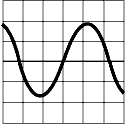
by the inverter. The ideal form of AC power is the pure, smooth sine wave; it
is what the electrical grid is supposed to provide. Different inverters
have different wave forms that range from rough approximations of a sine wave
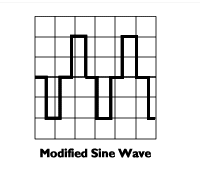
to pure sine waves that are smoother, "cleaner," than that of the grid. Modified Sine Wave is the wave
form most inverters produce. It is more accurately called Mod square wave, since
it more closely resembles a square wave
than a sine). Since this wave form isn't fluid in shape and has large "corners,"
it sometimes causes problems with certain appliances. Ultramodern
washing machines and a few other appliances with electronically controlled, variable-speed
motors won't work at all on mod-sine power, and some people in the RE field come
down hard on mod-sine inverters because of this. However,
mod-sine isn't as bad as all this might make it seem.
Most people experience no problems whatsoever
with their mod-sine system: We have found mod-sine
inverters to be great for low cost, off-grid homes and grid backup systems. Despite
the claims, mod-sine inverters work perfectly well with the vast majority of appliances
including most stereos and computers. We ran our entire shop off a Trace DR 2424
(the earlier version of the Xantrex TR) for years, and many of our more affordable
systems still use TR inverters.
The best part is:
they're the most reliable. In our years of RE work, we haven't had a single
DR orTR fail in the field. The next step up from mod-sine is
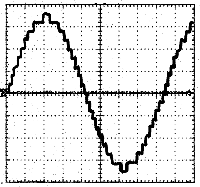
the wave form generated by the Xantrex/Trace SW and SW+ series. Trace calls it
a sine wave, but we call it a stepped-sine
wave, since it is composed of 34 to 52 little "steps", depending
upon the amount of load placed on the inverter at the time. The stepped sine is
utility grade and can be fed (sold) to the grid, although it may not be clean
enough for some critical applications. Stepped-sine inverters can cause the same
problems as mod-sine inverters, though less pronounced. (see side bar of
Mod sine problems).
The OutBack inverters also produce a stepped sine
wave, though they too are billed as sine wave inverters. Their wave-form is much
smoother than a Xantrex SW or SW+, having around five times as many steps. For
many applications the OutBacks seem have the best of both worlds: a very clean
wave-form, with surge capacity and the features of a general use inverter, such
as battery charger and transfer switch. Magnum sine wave inverters have a wave
form that is roughly twice as smooth as the OutBack. Pure
sine wave inverters are made by a few manufacturers.
As mentioned above, the power provided by them can be "cleaner" than
grid power. Exeltechs are the cleanest of the clean, being the preferred inverter
for off-grid recording studios. High-end recording studios with grid power are
sometimes set up with pure sine inverters for the musical equipment and recording
gear, so as to guard against noise and voltage dips and spikes from the grid.
Sometimes people will dedicate a small pure sine inverter for their stereo, computer,
or other critical load, while using a larger, less expensive mod-sine inverter
for all the other house loads. Top
2) GRID-INTERTIE vs. OFF-GRID:
Inverters for off-grid battery-based systems are designed for
stand-alone power systems that can operate independently of the electric
grid. Many of these inverters have AC inputs for grid power as well; so,
if grid power is available to the site, it can be used for back-up power and emergency
battery charging the way one would use a generator. In this way, an "off-grid"
inverter can have the option of grid back-up. This is different than what
is called grid-tie. Grid-tie
systems can be of two types: batteryless and battery-based.
Batteryless
grid-tie systems don't use batteries to store electricity, instead
they use the electric grid for that purpose: electricity is drawn (bought) from
the grid when energy use is higher than system production,
and electricity is fed (sold) to the grid when more energy is produced than is
used.
As utility companies become more accepting of grid-tied
RE systems with buyback or net
metering capabilities, they are becoming more popular. Having a batteryless
system not only does away with the considerable expense of buying and periodically
replacing batteries; also avoided are the hassles of maintenance, as well as the
need to monitor the batteries to make sure that the energy demands placed on them
balance the energy production, lest they become too drained. Since excess demand
will simply be handled by the grid, the result is a very self-regulating system
that needs little attention.
A batteryless grid-tie inverter, like the SMA
SunnyBoy, is able to accept a wide range of Solar module power that can be much
higher than the voltages standard with battery-based inverters (up to 600V with
the SunnyBoy 2500). Wiring a solar array for a higher voltage saves money on wire
and reduces the power losses associated with lower voltages. The biggest drawback
to a batteryless grid-tie system is the fact that the system will shut down when
the grid goes down and will not provide back-up power during a power outage. This
is done in order to protect utility workers who will be trying to restore grid
power. Battery-based grid-tie
systems combine the best of both worlds: surplus power can be sold to the utility
company, and power can be bought from the utility's electric grid when needed.
Plus, if grid power fails, the system does not shut down with it.
Programming is still being developed to keep up with all the choices possible
with this arrangement. When to sell, when to charge the battery, etc.
Note: the rest of this guide does not apply to batteryless inverters.
Top
3) PRICE & CAPACITY vs. NEED:
Price is obviously
a big consideration. Buying too much inverter is a waste of money: getting an
inverter with more power or more features than needed, or getting a pure-sine
wave inverter when modified-sine wave power would run all your loads perfectly
well. But not buying enough inverter can also be a waste: getting a cheapo that
will be a door stop in a year, a quality one that is smaller than you need or
might soon need, or a mod-sine to power sensitive electronics. The very first
step in selecting an inverter is to look critically at the loads it will need
to run. The cost of your inverter, and of your power system as a whole, is directly
related to the amount of electricity you use.
4) SIZING THE INVERTER:
To do this, you must first figure out and add together
the wattages of all the continuous loads
that will likely run simultaneously, in a highest electrical use scenario. (Relax,
absolute precision isn't important; it's best to overestimate a bit). These include
lights, home entertainment, computer, microwave, etc. (To help you with this,
see the Solar Sizer for a more complete listing of
household loads.) This total must be the same or less than the continuous wattage
rating of the inverter you buy. Next,
to determine the surge capacity of the inverter you need, add up the surge watts
of all the loads that might start at the same time. Then add this total to the
continuous wattage total you calculated above. Think of the water pump and the
washing machine turning on at the same time as the refrigerator compressor (three
surge loads) while you microwave dinner with the TV and half the lights in the
house turned on (continuous loads).
If your inverter is undersized,
a combination of loads such as this will trip the inverter's output breaker; this
is known as nuisance tripping,
and it truly is a nuisance. Inverter Power
Rating to start an AC well pump (with no additional loads) An inverter sized by these
minimum guidelines will dip its voltage during the starting surge. This is not
harmful, but it will cause lights to dim. Fluorescents may blink off, and desktop
computers may crash. To eliminate voltage dips, oversize the inverter by an additional
50% minimum plus the watts capacity required to handle other household loads at
the same time. Inverter Sizing Chart Copyright ©2002 by Dankoff Solar
Products, Inc
Link to Complete Dankoff
Article Top
5) CHEAPO
vs. QUALITY:
There
is a very important distinction to be made between the many cheapo inverters,
which are sold in import tool catalogs and big box stores, and the high quality
inverters made specifically for renewable energy applications.
They're both called inverters, but they're very different
products, each with its own purpose. The cheapo inverters are meant to be hooked
up to a car's battery for occasional use: to run a power tool or tv out
in the field for example. The inverters we sell are designed to run an independent
power system 24 hours a day, 7 days a week, for many years. The cheapo inverters
simply are not designed for continual use or made of components that can hold
up to it.
From
time to time we encounter home-brew-boys who insist that money spent on a
quality inverter is money wasted.
We also run into some of these same guys who decide to invest in some reliable
equipment, after burning through a couple of the cheapo inverters. It sometimes
takes some real world experience to realize that the purchase price is the
least important of all the differences between cheapo inverters and the quality
ones. In the long run they spent more money than it would've cost to do it
right the first time.
Let's
take a closer look at a couple of mod-sine inverters with comparable wattage ratings:
*
The
above chart is misleading in so far as the "cost per year" is based
only on the inverter's price, which, in the case of the offbrand 2500, does
not include a battery charger or transfer switch. So, for the comparison to
be truly equal, both of these should be added to the cost of the Brand X.
A 90amp, 12 volt battery charger would cost upwards of $300
(the DTR 2412 has a 120 amp charger), and a 30 amp transfer switch would
cost around $100. Now, since the charger and transfer switch are already incorporated
into the TR, labor and materials to wire the cheapo inverter, transfer switch,
and charger together should also be factored into the
equation. Thus, the true price of the cheapo inverter setup would be $650, plus
wire, conduit and labor, which will add up to a similarly priced system of much
lower quality that will last a fraction of the time that the TR will!
But you could also
just grab that Brand X 2500 (13.5 lbs.) with one hand and sling a Xantrex TR 2412
(45 lbs.) under the other arm, and you'll feel another big difference--the TR
and other quality inverters are transformer based, whereas the Coleman, and other
such inverters, use high-frequency switching (transistor based), which is much
more prone to burn out.
A
word to the thrifty: when price shopping, make sure you compare apples to apples.
And get some advice from a professional before you buy. If you are planning on
living with this equipment and want it to last, don't skimp; in the long run,
buying quality is the best deal.
Next:
Inverter Comparison Charts.
Link to Catalog for Current Listings.
Top
|